

PRODUCT ENGINEERING
The Product Design section of FactoryUniC brings you practical, hands-on brief documents tailored to help product teams in industrial settings design smarter, not just prettier. Crafted by experts in industrial engineering, every resource is actionable, grounded in real-world practice, and ready for immediate use.
Product Engineering
The Essential Product Design Checklist for Success
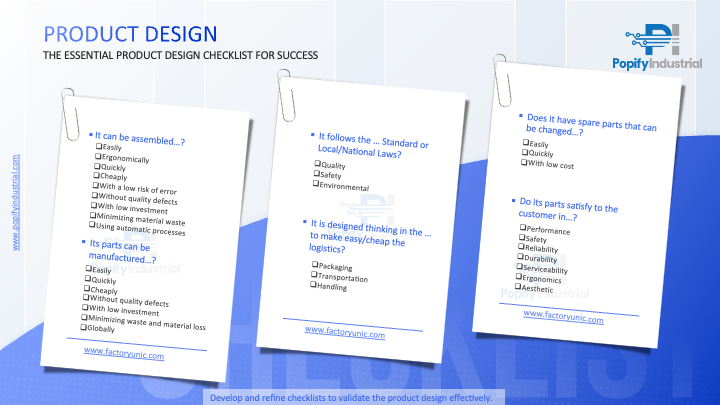
PRODUCT DESIGN. THE ESSENTIAL CHECKLIST FOR SUCCESS
This checklist serves as a blueprint for success, outlining the strategic and thorough process necessary to create products that do more than meet market standards—they set new benchmarks for excellence.
Check List to design a successful product.
1.- Can it be assembled…?
☐ Easily, with minimal manual effort
☐ With ergonomic safety for operators
☐ Quickly, with low cycle time...
Please download the attached PDF or PPT to access the complete content.
Product Engineering
How to Design Successful Products
HOW TO DESIGN SUCCESSFUL PRODUCTS
The 4 Engineering Methodologies Every Product Team Must Apply
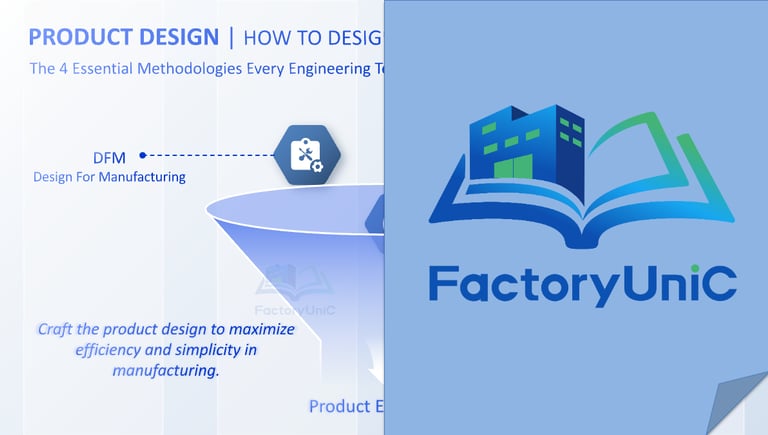
When designing a product, simply focusing on its aesthetics or functionality is not enough. Designers must also consider how the product will be manufactured and assembled and, crucially, how to ensure its quality and performance. Within this context, four pivotal concepts come to the forefront: DFM (Design for Manufacturability), .... Let's explore each:
1. DFM – Design for Manufacturability
This approach emphasizes designing components to be easily and cost-effectively manufactured. Some core principles include:
Simplify complex shapes and geometries...
Please download the attached PDF or PPT to access the complete content
Product Engineering
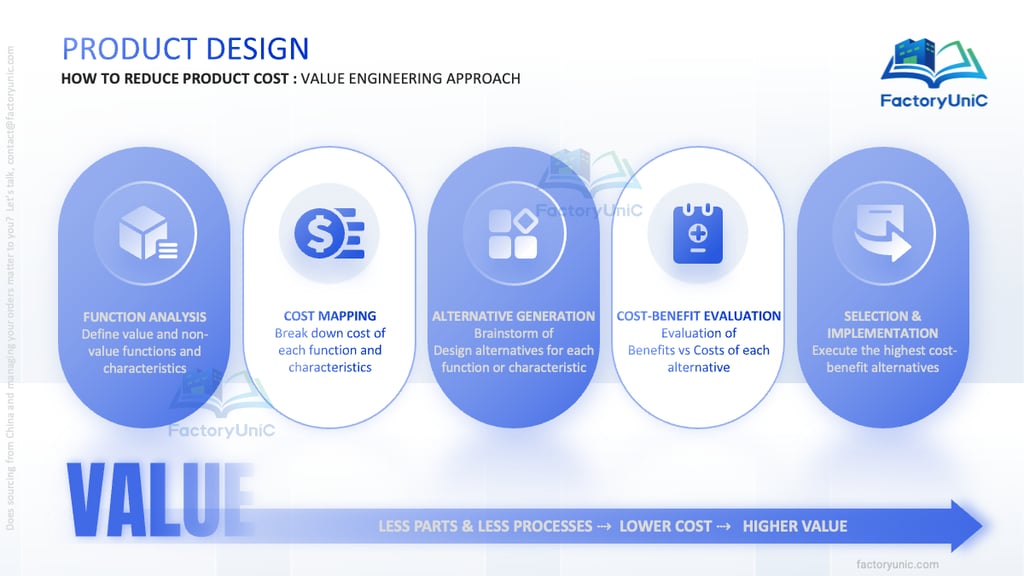
Cost Reduction - Value Engineering
PRODUCT ENGINEERING | VALUE ENGINEERING
A Systematic Methodology to Maximize Product Value Without Compromising Quality
What is Value Engineering?
Value Engineering is a systematic and disciplined engineering methodology used to improve the value of a product by analyzing its functions relative to cost. The goal is to maximize required functionality while minimizing total cost, without compromising performance, quality, reliability, safety, or compliance. The value of a product is defined by the ratio of its function to its cost, so value can be increased either by improving function or by reducing cost in a way that preserves essential performance.
Process Steps
1.- Information & Functional Decomposition
Objective: Understand the product and Decompose the product into functions.
Execution:
Classify functions into:
Value Functions: Mandatory for product operation, safety, or regulatory compliance.
Non-Value Functions: Aesthetic, redundant, legacy-driven, or over-specified features.
Map each function to the corresponding physical components.
Identify potential overengineering and duplicated functions.
2.- Cost-Function Analysis
Objective: Identification of cost-function imbalance (high cost, low functional contribution).
Execution:
Assign cost to each function (not only to each component).
Break down cost structure: material cost, manufacturing cost, assembly cost, testing and validation cost, warranty and lifecycle cost (when aplicable).
Quantify the cost contribution per function.
Highlight areas where cost is disproportionate to functional value.
3.- Generate Technically Viable Alternatives
Objective: Identify alternative technical solutions that achieve the same required function at lower total cost or higher performance.
Execute: Cross-functional teams (Engineering, Manufacturing, Quality, Supply Chain) generate alternatives taking in consideration: material substitution, part count reduction, simplify manufacturing process, manufacturing process change, component integration, geometry simplification, tolerance optimization, standardization and modularization, among others.
4.- Objective Evaluation
Objective: Evaluate alternatives using measurable engineering criteria.
Execute: alternatives are evaluated considering: cost reduction potential (unit and total impact), assembly time impact, DFMEA alignment, manufacturing complexity, lifecycle and maintenance cost, regulatory and safety compliance, and customer-perceived functional impact.
5.- Selection, Development & Implementation
Objective: Choose the solution with the highest value index, not the lowest acquisition cost.
Execution:
Develop selected alternatives.
Update DFMEA and control plans.
Measure quality and reliability impact.
📫 If you have any questions about this topic, please don’t hesitate to contact us at contact@factoryunic.com. We’ll be happy to assist you.
Product Engineering
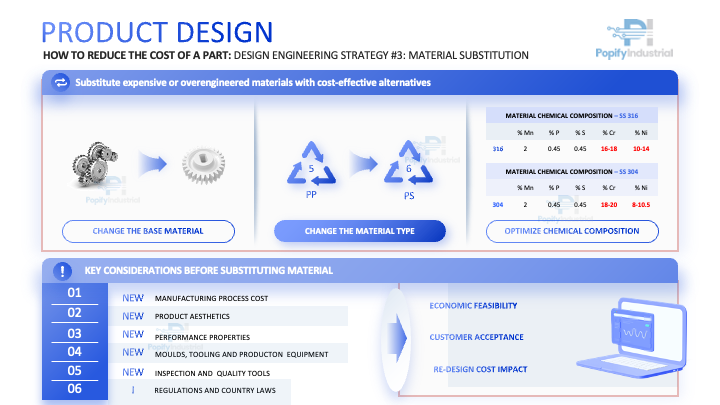
Reducing the Cost of a Product/Part: Strategy #3
REDUCING THE COST OF A PART: STRATEGY #3 — CHANGE THE MATERIAL
In design engineering, one of the primary objectives is to reduce costs. Here is a strategy to achieve it: Change expensive or overengineered materials with cost-effective alternatives.
Thress dimensions of material Changes.
1. Change the Base Material
Example: Metal → Plastic
→ e.g., Stainless Steel gear → Reinforced Polymer gear
...
Please download the attached PDF or PPT to access the complete content
Product Engineering
Reducing the Cost of a Product (Strategy #28): Tolerances Optimization
PRODUCT ENGINEERING - COST REDUCTION | COST REDUCTION THROUGH TOLERANCES OPTIMIZATION
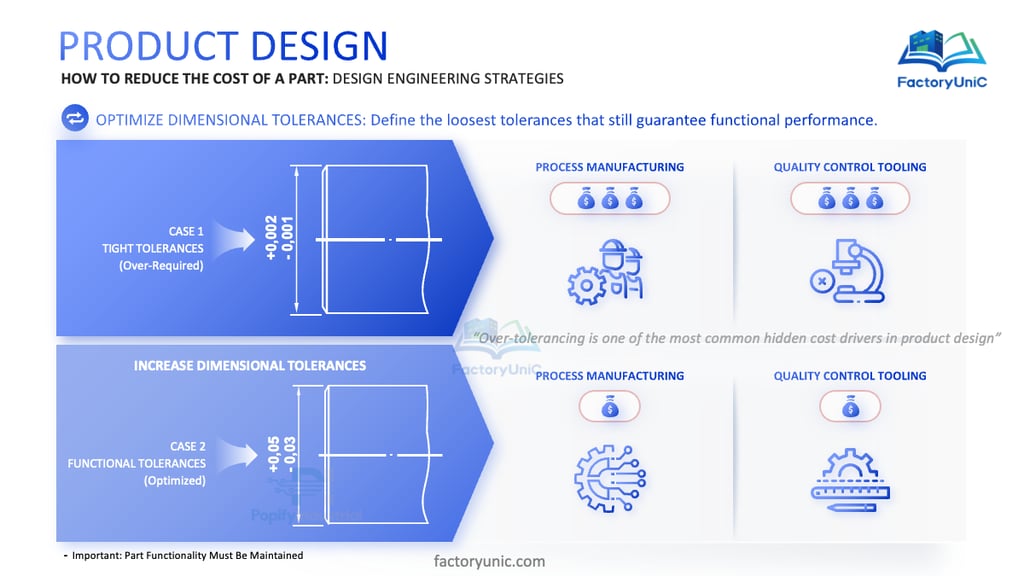
In design engineering, one of the primary challenges is reducing manufacturing costs while maintaining the functionality, quality, and reliability of a product, sometimes also preserving characteristics such as appearance.
A key factor influencing these costs is dimensional tolerances, the allowable variations in the size of a part. Often, parts are designed with tolerances that are stricter than necessary. By strategically adjusting tolerances, we can significantly reduce costs without affecting the performance of the product.
Why Do Tight Tolerances Increase Costs?
When a part is designed with unnecessarily strict tolerances, it leads to two primary cost-driving factors:
Higher Manufacturing Costs: Tight tolerances require more precise machining, and more advanced manufacturing processes, all of which increase production expenses. Additionally, they often lead to higher scrap rates.
More Expensive Quality Control and Tooling: The stricter the tolerance, the more accurate the measuring equipment needs to be to verify that the part meets specifications. High-precision gauges, CMM, and laser scanning systems may be required, significantly increasing costs.
Optimizing Dimensional Tolerances to Reduce Costs. Strategy.
Identify critical tolerances: Some dimensions are essential for assembly or function and must remain tight, while others may be relaxed.
Redefine tolerances for non-critical features: Increasing tolerances in non-critical areas wherever possible.
Collaborate with suppliers: Understanding manufacturing constraints and involving suppliers in the design phase can help set realistic and cost-effective tolerances.
⚠️ However, caution is required: Changing tolerances can affect product characteristics if not analyzed properly. The key is to balance cost savings with product integrity.
Engineering Potential Benefits of Optimized Tolerances
Reduced manufacturing and inspection costs
Shorter cycle times
Fewer rejected parts and less rework
Improved tool life and machine uptime
Greater flexibility in supplier selection
Only apply tight tolerances where they are functionally required, nowhere else
Tolerances are design decisions with financial consequences
If you have any questions about this topic, please don’t hesitate to contact us at contact@factoryunic.com. We’ll be happy to assist you.


Product Engineering
Reducing the Cost of a Product/Part: Strategy #9
PRODUCT ENGINEERING | REDUCING THE COST OF A PART: STRATEGY #9
When designing products, it's easy to fall into the trap of custom-designing every part. While this may offer maximum design freedom, it also introduces unnecessary complexity, cost, and risk.
One strategy to reduce part cost and simplify your product line is....
Please download the attached PDF or PPT to access the complete content
Product Engineering
Reducing the Cost of a Product/Part: Strategy #10
PRODUCT ENGINEERING | REDUCING THE COST OF A PART: STRATEGY #10
When designing products, it's easy to fall into the trap of custom-designing every part. While this may offer maximum design freedom, it also introduces unnecessary complexity, cost, and risk.
One strategy to reduce part cost and simplify your product line is....
Please download the attached PDF or PPT to access the complete content
Product Engineering
Reducing the Cost of a Product: Strategy #8
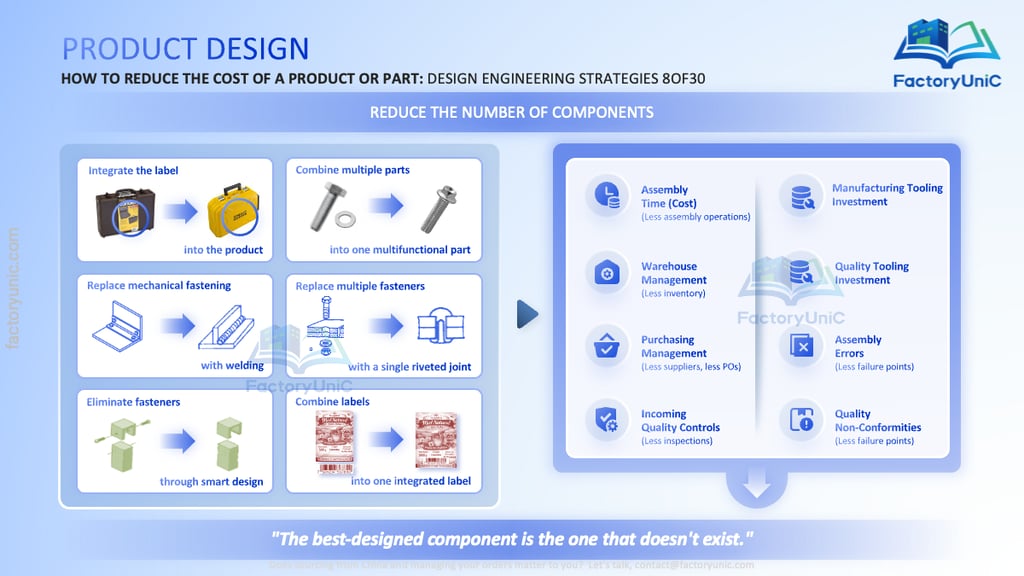
PRODUCT ENGINEERING - COST REDUCTION | COST REDUCTION THROUGH COMPONENT COUNT REDUCTION
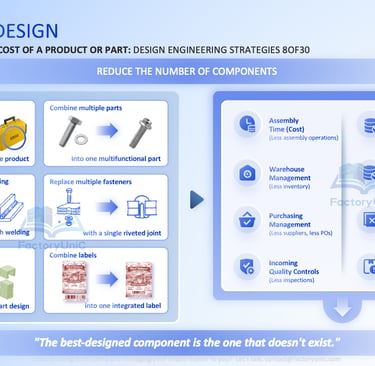
“The best-designed component is the one that doesn’t exist.”
Reducing the number of components is not just an engineering improvement. It is a strategic decision that impacts the entire value chain.
Practical Strategies to Reduce Component Count (examples)
1. Eliminate Fasteners When Possible
Weld instead of using screws (if no disassembly required)
Use rivets when serviceability is not needed
Replace screw + washer with flange bolt
Use snap-fit designs for plastic parts
Use bent sheet metal instead of multi-part assemblies
2. Integrate Functions into Single Parts
Use flange bolts (integrated washer) instead bolt and washer
Use structural features instead of added reinforcements
3. Design Self-Locating Geometry
Add positioning features directly in the part
Integrate guides and stops into geometry
4. Remove Non-Value-Added Components
Eliminate decorative elements without function
Integrate labels directly into molding process
Remove unnecessary brackets and covers
Always ask: Does this part add functional, structural, regulatory, or customer value? If not, eliminate it. If it needs to be added: Can we integrate it? Can we simplify it?
Operational Impact Across the Value Chain
Engineering Design
Simpler BOM structure | Reduces tolerance stack-up | Minimizes critical interfaces | Lowers dimensional variation risk | Fewer drawings and
documentation | Fewer Revision history | Fewer Engineering change management | Shorter design validation cycles
Purchasing & Logistics
Fewer Suppliers | Lower negotiation complexity | Fewer Purchase Orders | Fewer Engineering change management | Fewer storage locations | Lower inventory levels | Lower stock counting effort | Less tied-up working capital | Fewer picking errors | Improved turnover | Fewer obsolescence risk
Production
Faster Assembly. Fewer: Assembly operations & Assembly complexity | Fewer intralogistics movements
Process Eng.&Maintenance
Fewer workstations | Less tooling and fixtures | Simpler PFMEA | Fewer equipment repairings | Lower spare parts inventory
Quality
Fewer Supplier approvals and audits | Fewer Incoming inspection | Fewer Traceability | Fewer In-process inspection | Fewer supplier corrective actions (SCARs) | Fewer variability | Fewer quality risk | Fewer non-conformities | Fewer mistakes | Fewer quality tools calibration
Lower Materia Cost | Lower Labor Cost | Lower Inventory Investment | Higher Productivty | | Lower Capital Expenditure | Lower Quality Cost
📩 If you want to work with Chinese manufacturers that carefully consider the quality of their products, or If you have any questions about this topic, please don’t hesitate to contact us at contact@factoryunic.com. We’ll be happy to assist you.
Product Engineering
Cost Reduction - Modularity
PRODUCT ENGINEERING - COST REDUCTION | Modularity
Definition
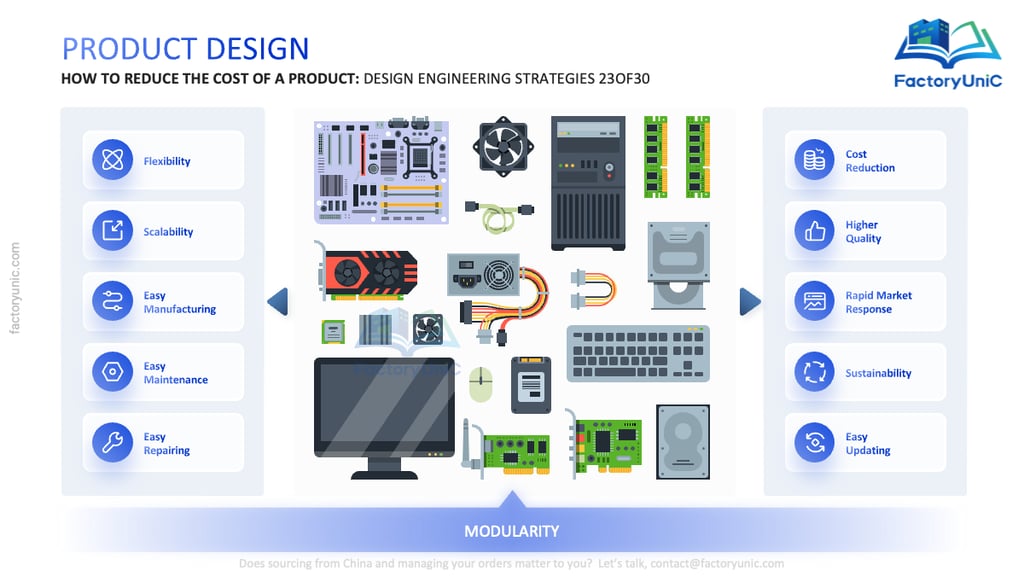
Modular design is an approach that involves dividing a system or product into independent and autonomous modules. Each module serves a specific function and can be interchanged, updated, or replaced without affecting the overall system's functionality. Modules are designed to be interoperable, meaning they can connect to each other in a standardized and seamless manner.
Advantages of Modular design
Flexibility (Rapid Customization and Ease of Updating): Modularity allows for swift adaptations to meet customer-specific requirements, ensuring that each product is tailored to the precise needs of its intended application. Modules can be updated independently to incorporate new technologies or improvements without needing to modify the design of the entire system.
Scalability: Facilitates the expansion or reduction of the product by adding or removing modules as needed.
Ease of manufacturing: Simplifies the manufacturing process by dividing the product into independent modules that can be produced and assembled more efficiently.
Ease of maintenance and repair: Dividing the product into modules makes maintenance and repair tasks simpler and faster, as defective modules can be easily replaced without affecting the rest of the system's operation.
Cost reduction: Standardizing modules and simplifying the manufacturing process can help reduce production costs and development times.
Higher quality: Allowing for individual optimization of each module, modular design can contribute to improving the overall quality and reliability of the product.
Sustainability: The modular approach promotes sustainability by allowing parts of a product to be replaced or upgraded without discarding the entire system. This reduces waste and extends the lifespan of products.
Rapid Market Response: By allowing greater flexibility in product configuration, modular systems enable companies to respond more quickly and effectively to changing consumer preferences and dynamic market conditions.
Economical Scale: Employing a standardized set of components across different models rationalizes inventory, simplifies maintenance, and scales production, leading to significant cost savings.
Reduced Development Time: The use of pre-designed and tested modules shortens the development cycle, allowing for faster turnaround from concept to production.
Example
An example of a product that follows modular design is a desktop computer. In a desktop computer, different components such as the CPU, graphics card, RAM, hard drive, power supply, among others, are designed as independent modules that can be easily assembled and replaced.
For example, if a user needs to upgrade the graphics performance of their computer for tasks such as gaming or graphic design, they can simply remove the existing graphics card and install a more powerful one without having to change the entire computer.
Likewise, if additional storage capacity is needed, an additional hard drive can be added or the existing hard drive can be replaced with one of higher capacity without altering the rest of the system.
This modular approach not only facilitates updates and repairs to the computer but also allows users to customize their hardware according to their specific needs, and manufacturers to offer a wide range of configuration options to suit different budgets and performance requirements.
📩 If you want to work with Chinese manufacturers that carefully consider the quality of their products, or If you have any questions about this topic, please don’t hesitate to contact us at contact@factoryunic.com. We’ll be happy to assist you.
Product Engineering
Reducing the Cost of a Part: Strategy #20
PRODUCT ENGINEERING | REDUCING THE COST OF A MACHINED PART: STRATEGY #20
Four Key Design Factors Engineers Must Consider
In industrial product development, the cost of a machined component is largely determined during the design phase. While many organizations focus on reducing cost during procurement or production, experienced engineers understand that most manufacturing cost drivers originate from design decisions. For machined mechanical parts, four fundamental design elements define the manufacturing cost:
....
These factors determine machining complexity, cycle time, tooling requirements, scrap generation, and equipment utilization. Understanding how each of these design decisions...
Please download the attached PDF or PPT to access the complete content
Product Engineering
Cost Reduction - Packaging Innovation
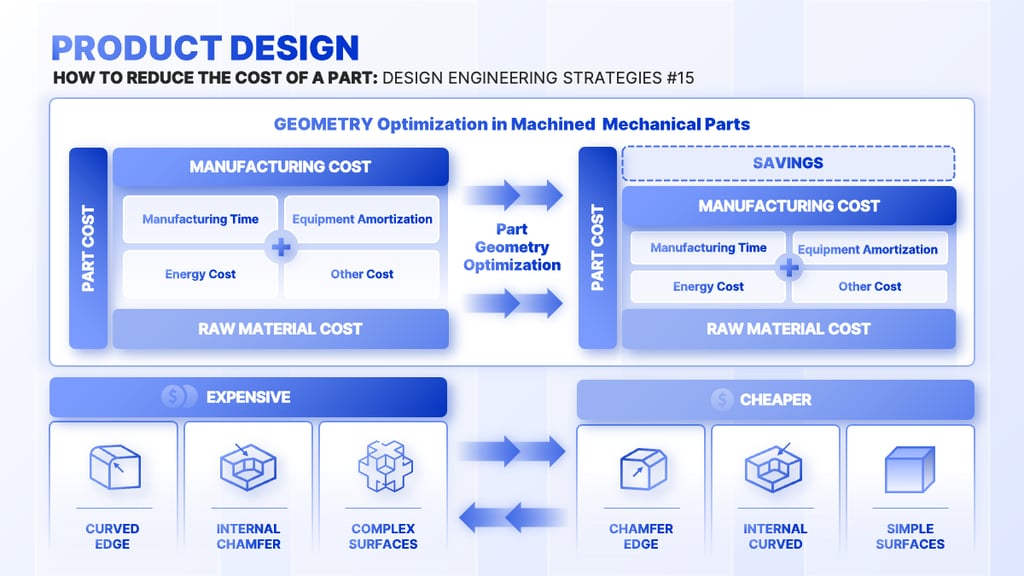
PRODUCT DESIGN | COST REDUCTION: Geometry Optimization in Machined Mechanical Components
In industrial product development, the geometry of a component is one of the primary factors determining its manufacturing cost.
While material selection is often considered a major cost driver, in many machined components geometry complexity has a significantly greater impact on total manufacturing cost. Complex geometries increase machining time, tooling requirements, programming complexity, setup operations, and manufacturing risk.
For this reason, geometry optimization is one of the most powerful cost-reduction strategies in product design.
This article explains how component geometry influences machining cost and presents practical design strategies to improve manufacturability while preserving functional performance.
Cost Structure of a Machined Component
To understand the impact of geometry on cost, it is necessary to analyze the cost structure of machined part.
The cost of a mechanical component can generally be divided into two primary categories:
Manufacturing Cost. Manufacturing cost is directly influenced by the processes required to produce the component. The main contributors include:
Manufacturing Time. Manufacturing time is often the dominant cost driver in CNC manufacturing. Longer machining cycles increase: Machine occupation time, Production lead time and Cost per part. Since CNC equipment represents a high capital investment, machine time is one of the most expensive resources in production.
Equipment amortization and Maintenance. Complex geometries may require: Multi-axis CNC machines (4 or 5 axis), High-precision equipment, Specialized tooling. These requirements increase equipment amortization and maintenance costs, especially in high-precision or low-volume production.
Energy Consumption. Energy usage increases with: longer manufacturing cycles, higher spindle loads, Intensive cutting operations. Although energy is usually a smaller cost contributor, it scales directly with machining time and cutting effort.
Operational Costs. Such as: Tool changes, Workpiece repositioning, etc. Additional manufacturing costs may include: Tool changes, Workpiece repositioning and additional setups, Specialized fixtures, Programming and CAM preparation time. These factors can significantly increase total production cost, especially in complex parts.
Raw Material Cost. Material cost depends primarily on:
Material type (steel, stainless Steel, aluminum, titanium, etc.)
Raw material stock dimensions.
Material waste volumen during manufacturing
Influence of Geometry on Manufacturing Complexity
The geometry of a component directly determines the manufacturing process required to produce it.
Certain geometrical features significantly increase manufacturing complexity, machining time, production risk and therefore cost.
Examples of cost-intensive geometries include:
Free-form curved surfaces
Complex 3D contours
Deep internal cavities
Internal cavities with por tool accessibility
Undercuts
Sharp internal corners
Internal chamfers requiring specialized tooling
Producing these features frequently requires:
Multi-axis machinings
Custom cutting tools
Multiple setups
Increased programming complexity
As a result, manufacturing time and cost increase substantially. In high-volume production, even small geometric inefficiencies can generate significant cumulative cost increases.
Geometry Simplification as a Cost Reduction Strategy
Geometry simplification is one of the most effective methods for reducing manufacturing costs.
The objective is not to remove functionality, but to achieve the same function with simpler, more manufacturable geometry.
Practical Strategies for Geometry Optimization
Replace Complex Curves with Standard Radii. Free-form surfaces require advanced machining paths. Standard radii allow faster machining with conventional tools.
Replace Complex Transitions with Chamfers. Chamfers are often faster to machine than complex blended curves.
Prefer Planar Surfaces Over Free-Form Geometry. Planar surfaces enable simpler machining operations and easier fixturing.
Favor 2.5D Geometries. Whenever possible, designs should rely on 2.5D geometries, which can be produced using simpler CNC machining operations without requiring continuous multi-axis toolpaths.
These simplifications can significantly reduce:
Machining cycle time
Tool wear
Programming complexity
Production variability
Geometry optimization is a powerful strategy for reducing manufacturing costs. By simplifying component geometry while preserving functional requirements, engineers can significantly improve manufacturability and production efficiency.
📩 If you want to work with Chinese manufacturers that carefully consider the quality of their products, or If you have any questions about this topic, please don’t hesitate to contact us at contact@factoryunic.com. We’ll be happy to assist you.
Product Engineering
Cost Reduction - Packaging Innovation
PRODUCT ENGINEERING - COST REDUCTION | PACKAGING INNOVATION
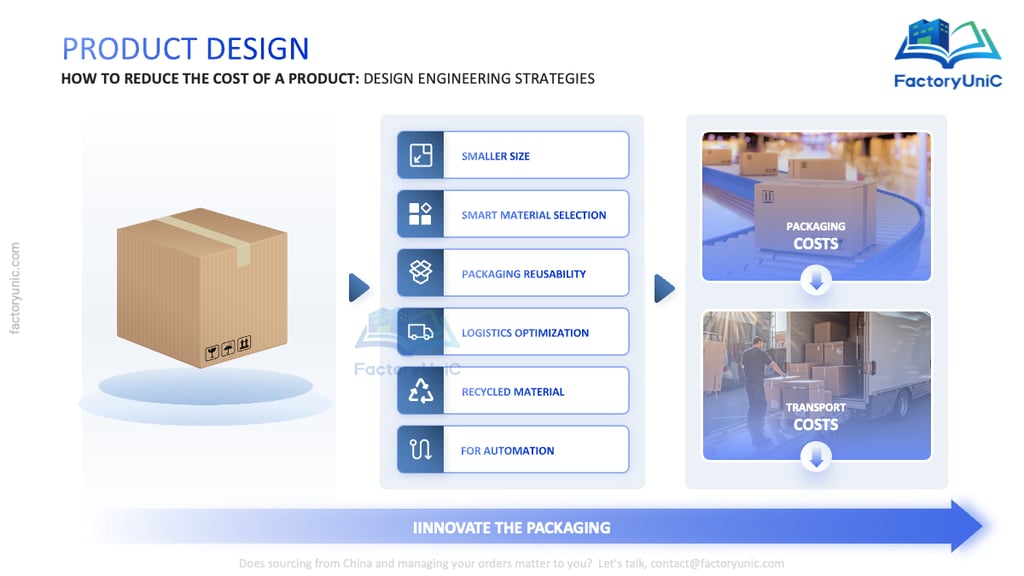
Cutting Costs through Packaging Innovations: A Design Engineer's Guide
In today's economy, cost efficiency is more crucial than ever, especially in the production and distribution of goods. One of the most promising fields for cost optimization is packaging. Herein, I present a strategic guide for innovation in packaging design that not only reduces costs but also enhances sustainability and logistic efficiency.
1. Packaging Size Optimization: Customizing packaging size to fit each product perfectly is essential. Using more packaging than necessary, such as unnecessary plastic wrapping, oversized boxes, or excessive filler, directly impacts purchasing costs, warehouse space utilization, transport efficiency, and environmental footprint.
2. Smart Material Selection: Choosing lightweight yet durable materials is a priority. Materials like corrugated cardboard or biodegradable plastics can provide the necessary protection without the additional weight, translating into significant savings on shipping. Replace traditional solid wood with plywood or lightweight corrugated materials. Lower cost and lighter weight reduce freight charges. No fumigation required for export shipments (ISPM-15 exempt).
3. Packaging Reusability: Packaging doesn't have to be single-use. Designs that offer reusability or additional functions after the initial delivery provide added value that consumers are willing to pay for.
4. Logistic Optimization: Packaging that is easy to handle, store, and transport significantly reduces labor costs and improves logistic efficiency. Designing packaging that stacks well and takes up less space can revolutionize the storage and transportation of goods.
5. Recycled Material: Using recycled and recyclable materials not only cuts costs but also attracts environmentally conscious consumers, opening new markets and branding opportunities.
6. Packaging Automation: Automated packaging systems are designed to work with consistent and easy-to-handle packaging. A design compatible with these systems can greatly reduce labor costs.
📩 If you want to work with Chinese manufacturers that carefully consider the quality of their products, or If you have any questions about this topic, please don’t hesitate to contact us at contact@factoryunic.com. We’ll be happy to assist you.
Every week, we’re sharing two fresh training resources focused on the topics our followers care about most.