
OPERATIONS
The Operations Management section of FactoryUniC offers a collection of clear, practical training resources in PDF and PPT formats, focused on optimizing production processes and strengthening operational performance in industrial environments. The content goes straight to the point — no unnecessary theory — so it can be applied immediately to real challenges on the job. Behind these materials is a team of professionals with more than 20 years of hands-on experience in global industrial operations, ensuring that every insight is grounded in practice, not just concepts.
Management
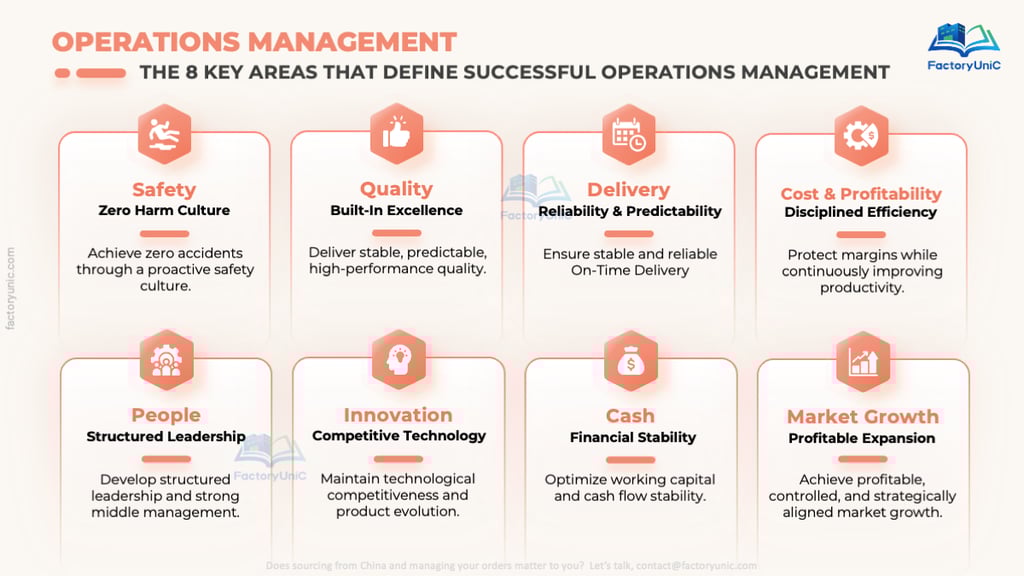
Operations - The 8 key areas that define successful Operations managment
OPERATIONS | THE 8 KEY AREAS THAT DEFINE SUCCESSFUL OPERATIONS MANAGEMENT
The Operations Department must maintain constant focus on eight fundamental strategic areas: safety, quality, delivery deadlines, project cost and profitability, people development, innovation in products and services, financial stability, and commercial performance.
Each of these areas requires discipline, structure, and continuous monitoring.
1. Safety
Safety is the highest priority in any responsible industrial organization. Protecting the physical integrity and well-being of every employee is non-negotiable. It goes beyond regulatory compliance; it requires building a culture where risks are proactively identified, controlled, and eliminated.
2. Quality
Quality must not be inspected at the end; it must be built into the process. Stable processes, clear standards, and systematic root cause elimination are essential to ensure customer satisfaction and protect the company’s reputation.
3. Delivery Deadlines
Meeting commitments builds trust and strengthens market positioning. Reliable delivery performance reflects effective coordination between planning, purchasing, production, and logistics.
4. Project Cost and Profitability
Executing projects is not enough; they must be profitable. Cost control, productivity, and waste elimination are critical to protect margins and ensure long-term business sustainability
5. People
Processes do not improve themselves; people improve processes. Developing middle management, investing in continuous training, and fostering a culture of accountability are key to disciplined and consistent execution.
6. Innovation in Products and Services
Innovation is essential, but it must be industrially disciplined. New developments must be scalable, manufacturable, and aligned with operational capacity to avoid negative impacts on quality and cost.
7. Financial Stability
Efficient management of working capital, inventory, and investments ensures liquidity and growth capacity. Financial stability enables the organization to execute strategy with confidence.
8. Commercial Performance
Operations and sales must be aligned. Commercial growth is only sustainable when production capacity, quality, and resources are fully prepared to support it.
Business success does not depend on optimizing a single factor, but on maintaining balance across these eight pillars. When one weakens, the entire system feels the impact; when they are aligned, the organization becomes stable, profitable, and ready for sustainable growth.
📫 If you're looking for manufacturers of high-tech products or you have any questions about this topic, please don’t hesitate to contact us at contact@factoryunic.com. We’ll be happy to assist you.
Operations Management
Sales Forecasting
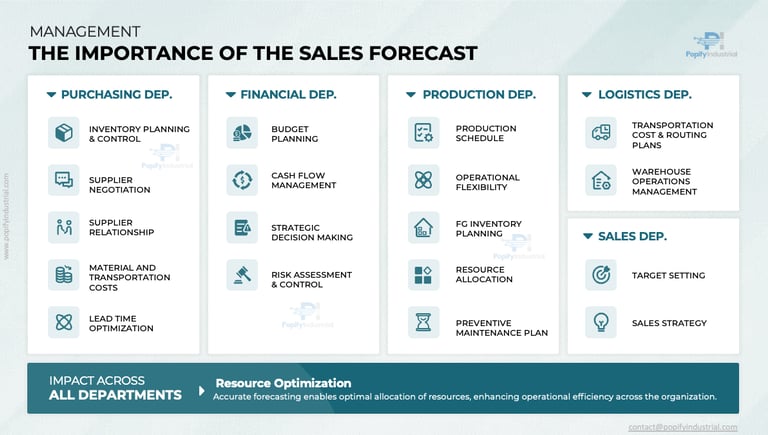
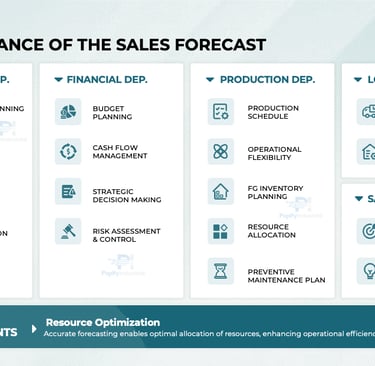
WHY SALES FORECASTING IS THE BACKBONE OF FACTORY OPERATIONS
Anticipating the future is crucial in the supply and demand dance. Sales forecasting guides departments, ensuring they actively shape the marketplace. Here's how a precise forecast benefits each department:
PURCHASING DEPARTMENT
1.- Inventory Planning & Control
If you know how much you’ll sell, you know how much raw material to buy — avoiding overstocking or shortages. If demand drops and you don't forecast it, you might end up with months of unused components.
2.- Supplier Negotiation
Better volume visibility = better price deals. Committing to a supplier with accurate volume projections can unlock discounts...
Please download the attached PDF or PPT to access the complete content.
Operations Management
Factory Location: Where you should put your factory?
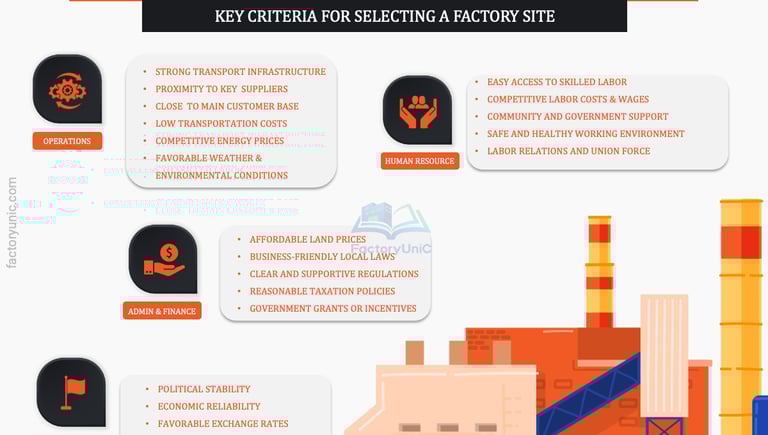
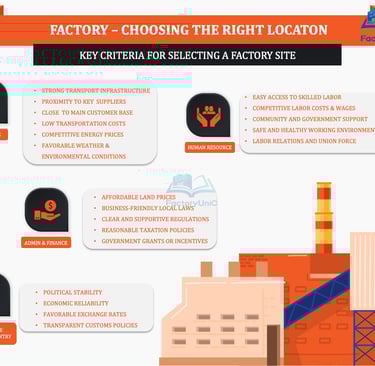
WHERE SHOULD YOU PUT YOUR FACTORY?
Let’s get to the point. You can have the best product in the world. A product so pretty it could win design awards. But if you put your factory in the wrong place, you're screwed. This isn’t about finding a cheap spot with nice views. This is a strategic decision — the kind that can make or break your business. Here’s what really matters when choosing where to build your factory.
Operations Considerations
Transport Infrastructure: Availability of roads, ports, and logistics networks for raw material supply and product distribution.
Nearby Suppliers: Proximity to key suppliers to reduce transport costs and easy management.
Proximity to Main Customers: Reducing delivery time and transportation...
Please download the attached PDF or PPT to access the complete content.
Operations Management
Delivery On-Time - Risks Analysis
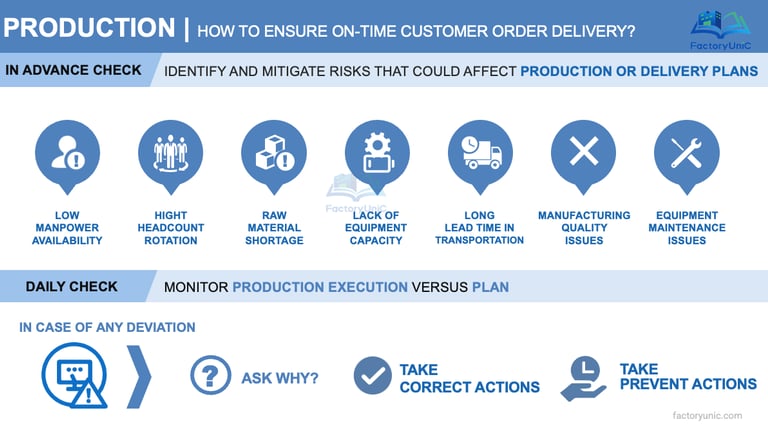
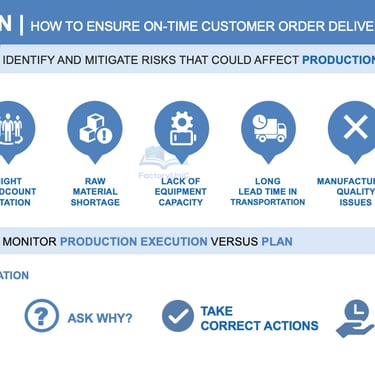
ON-TIME CUSTOMER DELIVERY: HOW OPERATIONS EARN (OR LOSE) TRUST
Let’s be clear:
Missing a delivery date is not a minor issue. It’s a breach of trust. And when you break trust in business, you lose customers — sometimes forever.
It doesn’t matter how innovative your product is, how efficient your technology, or how hard your team works. If the customer doesn’t receive what they ordered, when they expected it, nothing else counts.
On-time delivery (OTD) is not just a logistics KPI. It’s a diagnostic — a real-time indicator of how well your entire operation is functioning. From planning to purchasing, from production to quality control and logistics, one weak link can compromise the entire system...
Please download the attached PDF or PPT to access the complete content.
Management | Story
Measure What You Want to Improve
OPERATIONS | WITHOUT MEASUREMENT, THERE IS NOT IMPROVEMENT
Here’s a short, realistic story I’ve seen play out in many manufacturing plants.
A simple story. But an uncomfortable one.
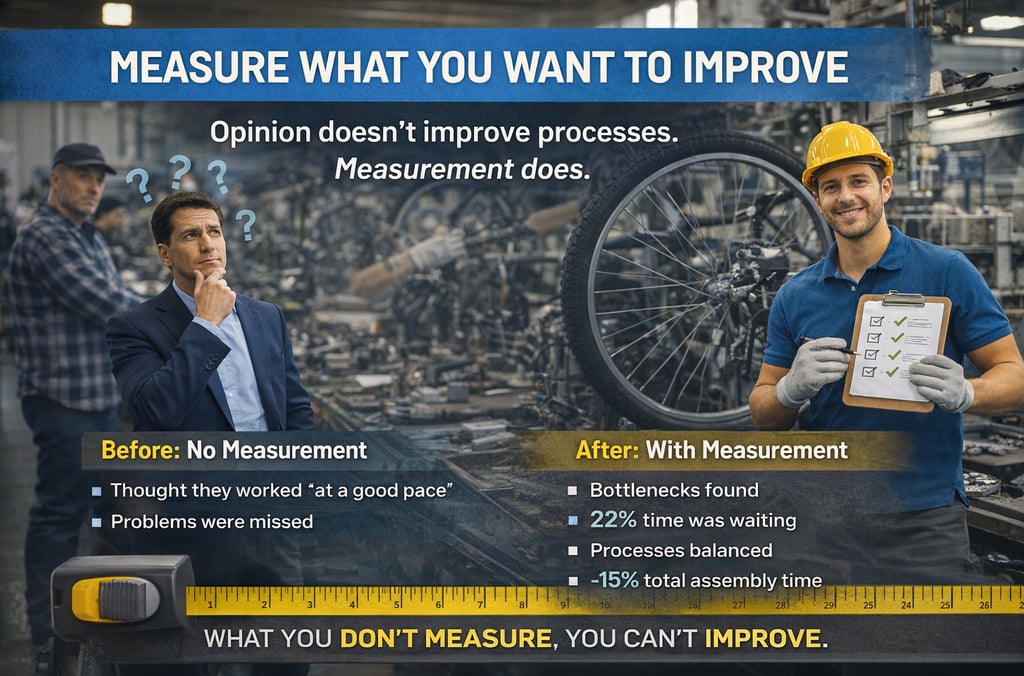
Because it puts a hard truth on the table: If we’re not measuring, we’re just giving opinions. And opinions don’t improve processes.
In a small bicycle manufacturing plant, the owner was proud that his operators worked “at a good pace.” There were no stopwatches. No recorded cycle times. No scrap tracking. Everything was done “the way we’ve always done it,” relying on the team’s experience.
One day, a key customer asked whether they could shorten the delivery time by one week. The owner replied confidently: “We work fast. I’m sure we can.”
But when they tried to speed up production, reality showed up: parts were missing at critical moments, some operators overlapped tasks, others were waiting on materials without realizing it, and assembly errors increased under pressure.
The order was delayed. The customer walked away.
Frustrated, the owner hired a young engineer who started with something very simple: measurement: he measured cycle times, the waiting time, the defects by workstation., the rework and the work-in-process inventory, among others.
Within a few weeks, the data told the story: 22% of total production time was pure waiting, two stations were creating bottlenecks and a small change in sequencing reduced total assembly time by 15%.
The owner, surprised, asked: “Was all of this happening right in front of us?”
The engineer replied: “It was always there. You just couldn’t see it. What doesn’t get measured doesn’t get seen. And what doesn’t get seen doesn’t get improved.”
📫 If you're looking for manufacturers of high-tech products or you have any questions about this topic, please don’t hesitate to contact us at contact@factoryunic.com. We’ll be happy to assist you.